


In eastern Brooklyn, where the neighborhood is rapidly growing and changing, our young friars are taking their time to grow into their Capuchin identity.
Last summer, our Province and the Province of the Stigmata began a collaboration in post-novitiate formation. After the novices of our Province and the Stigmata Province made their first profession of vows, they moved to St. Michael Friary in East New York. St. Michael has been the setting for initial formation in the past. For many years it was the house of formation for our postulants.
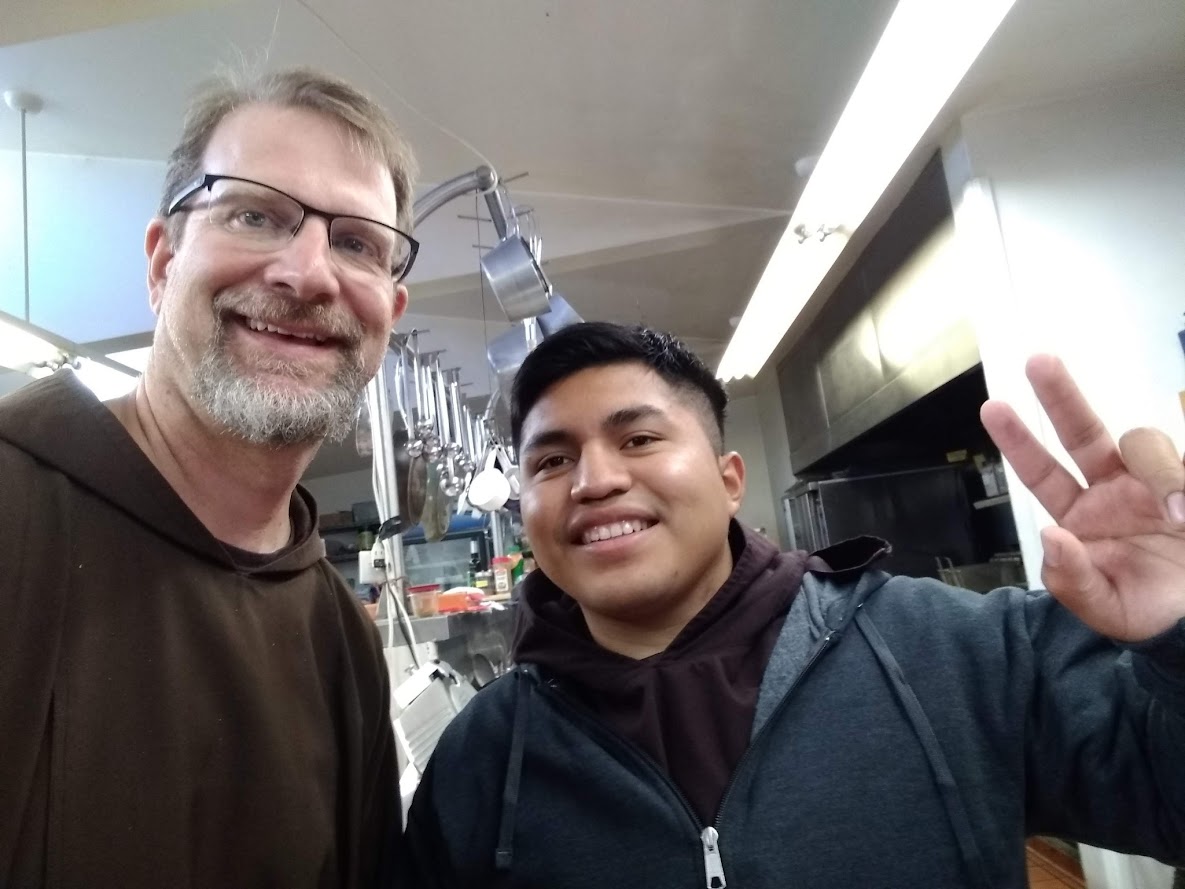
This year, two young friars are in residence with their formation director. Br. Shawn Natola is from the Province of St. Mary. Br. Yovani Salas is from the Province of the Stigmata, and so is the formation director, Br. Miguel Ramirez. Brothers Shawn and Yovani are discovering more deeply what it is to be a Capuchin friar as they work, pray, and live together.
Migration and a Redirection
Post-novitiate is the third phase of initial formation into Capuchin life. It follows immediately after one year of postulancy and one year of novitiate. From 2002, our Province sent its new post-novices to San Lorenzo Friary in Jamaica Plain, Mass. There, our friars immediately began academic studies in preparation for pastoral ministry and ordination to priesthood.
Beginning in 2022, our Province decided to defer putting post-novices into studies so that they could focus first on integrating the Capuchin charisms into everyday life. “In the past, goals for post-novitiate were different than they are today,” explained Br. Lake Herman, the provincial director of initial formation. “We focused more on integrating novices into a more active ministerial program and on education. Now the Capuchin charisms are more in the forefront.”
Two of our post-novices, Br. Gabe Conlon and Br. Leo Rojas, did their years of integration in Jamaica Plain. Now we have taken the further step of moving the year of post-novitiate integration to Brooklyn.
After Brooklyn, Brother Shawn and Brother Yovani will advance to theological studies. But first things first, said Brother Miguel: “The seminarian identity seemed more important before, but in this new model, the identity is of a Capuchin first—developing spirituality and formation as a Capuchin.” Brother Lake added: “Before, when the guys studied theology, they had the identity of a student. After completing our current program, they will go into their studies as Capuchins first, so they know who they are. They can be doing their college studies from a distinctly Capuchin perspective.”
Brother Miguel agreed. “Capuchin identity is important. The new model changes the focus to ‘I am a Capuchin!’ ”
For Brother Shawn, the post-novitiate is his first experience of living the Capuchin life in his home province. He completed his postulancy in Milwaukee, Wis., and his novitiate in Santa Ynez, Calif. Now he has the opportunity to develop his Capuchin identity within the provincial fraternity. By delaying his formal studies, he gains more opportunities to form lifelong relationships with his fellow friars of the Province of St. Mary.
Provincial Collaboration
Brother Miguel and the Stigmata Province have experience with this model of formation through the Capuchin charisms and so were the perfect choice for collaboration with the Province of St. Mary.
Fraternal collaboration between provinces in Capuchin formation is not new. The novitiate program in Santa Ynez is a collaboration of all the English-speaking provinces of the North American and Pacific Capuchin Conference. There are three interprovincial postulancy programs in the United States, including the one we participate in, in Milwaukee. Fraternal collaboration in post-novitiate is the next frontier. “We are responding to the general minister of the Capuchin Order in Rome, who asked that all North American provinces consider a single post-novitiate,” said Brother Shawn.
Brother Miguel said, “The collaboration is an inspiration in the sense that all the provinces are now advocating for collaboration, taking their signal from Rome.” The guidebook for the program is called the Ratio Formationis, which sets norms for the provinces in how they create and execute their formation programs. It provides guidance on the overall objective of post-novitiate, while allowing provinces latitude in the specifics of their programs. “This document was written many years ago but is more charismatic than juridical,” says Brother Miguel. “The Ratio Formationis lays out the values and important ingredients that must be included in every program. Each formation program does not have a dictated schedule; the important thing is that the foundational values are expressed and lived. Like a recipe, the final product might have a different flavor and taste.”
Local provincial leadership also does not adopt a heavy hand. “The provincial council is only involved at a higher level in terms of what formation classes they should be teaching,” says Brother Lake. “How they do it is up to the post-novitiate director.”
Stages
Brothers Yovani and Shawn reflected on the formation process so far.
“Every stage of discernment has its own objective,” said Brother Yovani. “Postulancy was a time for me to know the friars and for them to know me. It gave me a better understanding of religious life. In my own experience I had different, sometimes unrealistic, expectations of what religious life is.
“Novitiate was to prepare me for vows. More time was given to prayer and study. Being in a community of 15 guys, we had a real-life fraternal experience.
“In post-novitiate, we take what we learned in postulancy and novitiate and apply it. There is not the intense formation that there was before. but now we are expected to go into the world and practice what we learned. I find myself now really living the life of a Capuchin and maneuvering the challenges that come with life as a Capuchin. And it is preparing me for solemn vows.”
Brother Shawn said, “Canon law dictates a minimum of three years of temporary vows for all religious orders to ensure that they can commit to solemn (perpetual) vows. It is a deepening of relationship with Christ and with the order. The post-novitiate is within the Province to help the simply professed determine whether they want to become a ‘forever friar.’ ”
A Day in the Life
To get to being a forever friar requires hard work, introspection, and a life structured around prayer and service. “We are called to pray always, but we also structure prayer around the Roman Liturgy of the Hours,” said Brother Shawn. “We begin at 7:30 a.m. with morning prayer followed by Mass, then we go to ministry or class from 9 until about 2 or 3 p.m.” His day continues with evening prayer at 5:45 p.m., dinner at 6, and night prayer at 9.
Worked into this schedule are in-house studies that cover the Capuchin saints, Franciscan spirituality, the Capuchin Constitutions, and Scripture. “We go by a two-year cycle, Year A and Year B,” said Brother Miguel. “Year A might be Capuchin saints. Year B might be more about the writings of the Capuchin Order, for instance. This yearly cycle is not in use among all provinces, but it is being encouraged by the general minister.”
Time to Minister
Ministerial formation is a significant part of the post-novitiate program, but it is not the primary focus. “20 hours maximum per week is allowed for ministry,” said Brother Miguel. “We must have an active presence where we serve, but [ministry sites] cannot depend on us. We are not meant to be relied upon, because we must be able to change the schedule to attend to other things.” As Brother Shawn adds: “Our schedule works around the life, not the life around the work.”
Brothers Shawn and Yovani serve in several ministries at St. Michael-St. Malachy Parish. They teach catechism classes on Sundays. Twice a week they work at the parish meal and clothing program, begun in 2022 by Br. Francisco Serrano to serve migrants from Venezuela seeking asylum. “At its height, we served almost 120 people in a day,” said Barbara Garcia, who now manages the program with her daughter Vanessa. “So the brothers are a really big help to us!”
The brothers also serve meals twice a week at Neighbors Together, a local community organization that fights poverty, hunger, and homelessness in Bedford-Stuyvesant, Brownsville, and Ocean Hill, three of the poorest neighborhoods in New York City.
Personal Goals
As they fullfill the formation objectives of the Order and their province, the post-novices are encouraged to set their own personal objectives. For instance, says Brother Lake, “When they first land, in Brooklyn, they don’t know the lay of the land, but they are free to suggest ministries.”
Brother Shawn came away from his novitiate resolved to deepen his contemplative life. “I came away from novitiate believing that each of us novices had a different experience. There was a subjective quality to the experience which made it richer. For me post-novitiate is a time of recommitment to a life of prayer and fraternity, so I am asking myself, what does this mean today and what does this mean tomorrow?
“What does it mean for Brother Shawn to be a prayerful fraternal brother? The Lord seems to be speaking to me through these charisms in particular.”
Both Brother Shawn and Brother Yovani are embracing this time to reflect specifically on what God is calling them to in their Capuchin vocation. “Now that I am back in ministry in a more regular fashion, I realize how much I enjoy fixing things. I find it satisfying,” Brother Shawn said. “Also, I have been involved in men’s ministry, and I have helped organize men’s conferences. The more I am exposed to life in the parish, the more I feel the Lord may be speaking to me in the desire to see men flourish.”
For his part, Brother Yovani has discovered that his love of music may be one of the ways in which God is calling him to serve. “Since the beginning, formation has been a time to discover my talents and gifts,” he said. “I have discovered a love of music, specifically playing the guitar.” He plays for Masses at St. Michael-St. Malachy and has also been given responsibility for liturgical music in the Stigmata Province. “That is among my own personal goals—to use my gift of music in my prayer.”
Brother Yovani, who comes from Chiapas, Mexico, is discerning a call to serve across linguistic and cultural borders. “My parents moved here when I was three, so I grew up bilingual,” he said. “Another goal of mine is to strengthen my Spanish so that I can expand my opportunities to serve in anything the Lord calls me to. Opportunities have already come to me, as the friars have already asked me to translate documents.”
To ensure that the post-novices are staying on track, there are periodic assessments by the Province. There are mid-year and year-end evaluations. There are monthly meetings during which goals and concerns are reviewed. Brother Miguel and Brother Lake review feedback from other friars from their partners in ministry. Brothers Shawn and Yovani also conduct peer evaluations and self-evaluations.
This kind of self-evaluation yields fruit. “My discernment recently has been a realization that in order to live in poverty we have to be detached,” Brother Shawn reflected. “I am even learning to detach from my ideas and what I want to achieve. We even have to detach ourselves from the good things to let the Holy Spirit guide us.”