



Br. Tino Arias Reflects on Being a General Councilor
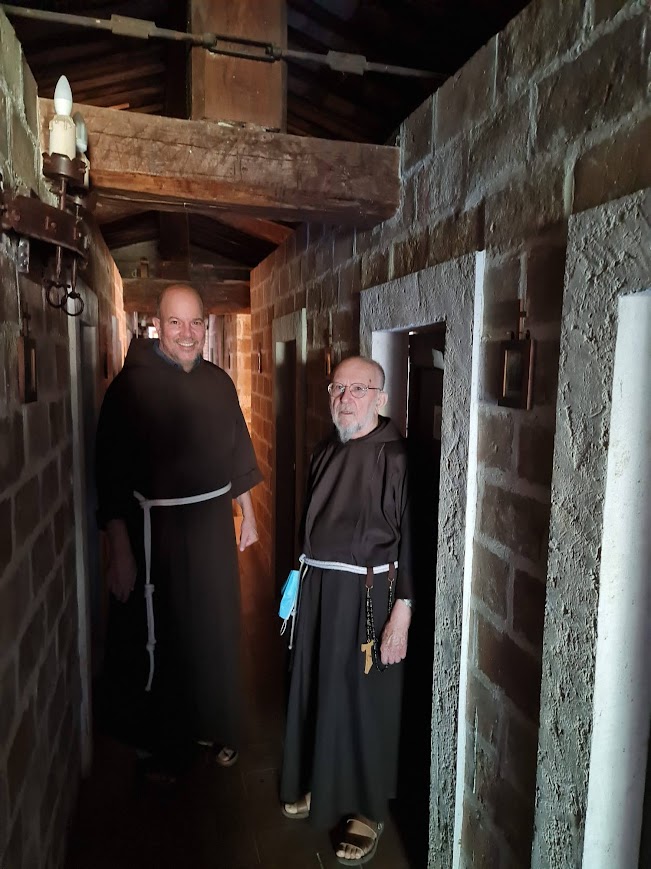
In August, Br. Celestino Arias finished his six-year term on the general council of the Capuchin Friars Minor, which helps the general minister of the Order to govern the global Capuchin fraternity. He represented the North American and Pacific Capuchin Conference while also being a voice for friars in rapidly growing jurisdictions of the Order in Africa and Asia.
Brother Tino, who lived at the Capuchin general curia in Rome, has now rejoined his brothers in the Province. He is eager to see what God has in store for him in the next phase of his Capuchin vocation. He sat with The Capuchin Journey for a conversation on Nov. 13, 2024, to reflect on his service to the Order. This interview has been edited for brevity and clarity.
Tell us about some of the Capuchin general council’s most significant decisions during your term.
The first one is having the pan-American Capuchin gatherings. We wanted to bring together all the Capuchins of the Americas, from Argentina to Quebec. We came together to look at challenges, to look at strengths, and try to create a common vision for the future. And the reason we focused on the Americas is because the Order for the longest time has been centered in Italy and in Western Europe. And it’s no secret that the Church in Europe is going through a crisis. Italy went from 24 provinces to less than 12. Huge provinces like Holland, Belgium, and Austria are now just custodies. England is just a delegation. But we see that there is enough life in the Americas. We can’t keep looking to Europe for leadership. We have to create leadership.
[The gatherings] helped break down barriers… There were all these stereotypes, but when we came together to pray, [and] everyone got a chance to participate, it was really a beautiful example of our fraternal spirit. Things are happening now that weren’t before. There is now a collaboration between Haiti and Quebec, the only two French-speaking circumscriptions in the Americas. Mexico and some Northern American provinces are going to create a house right on the U.S.-Mexico border. The migration crisis is huge, and what a beautiful testament– Mexican friars and American friars living, praying, and ministering together.
Now every three years, we’ll have this gathering, which I think is a great testament to that process.
The other thing that we have been pushing that I think is very positive is fraternal collaboration. And that’s something that I think the Americas, and especially North America, are doing particularly well. We don’t just accept friars from India, from Africa, and other places, but we also really integrate them. We’ve had two provincial ministers now who were Indian-born friars Almost every single provincial council has at least one or two friars from India, from Africa. They’re really integrated. They’re involved in formation. We have pastors. And that’s giving us a second chance. Fraternal collaboration is really giving us a second chance.
What were your distinctive contributions to the work of the general council?
I’ve been involved in the Capuchins’ international solidarity office for 15 years. So I’ve made a lot of connections, contacts. I have a lot of knowledge of the Order beyond, in developing countries. I’ve lived in Africa, I’ve lived in Brazil. In many ways, I’ve been able to give voice not just to North America but also to parts of the Order that in some ways are underrepresented. There are so many friars in those parts of the world. When I was elected, when people came to congratulate me, one of the first to get in line were the Africans.
Languages help. I didn’t just do visitations to North America. For example, Angola is African but Portuguese-speaking. Neither of the African general councilors speaks Portuguese. Since I speak Portuguese, I did the Angola visitation. For Chile, they needed an economic visitation. The general councilor for Latin America didn’t have the experience with economic solidarity that I did, so I was able to do that visitation. So in a way I was able to expand my role beyond general council meetings, technical meetings, visitations, and provincial chapters.
Describe what it was like to work with the other friars on the general council.
It was challenging. We were being too reactionary. A problem would come, and we would react to it. That seemed to be the dynamic for two years, until Covid. Then during Covid we came up with this new model of collaborating. Covid really helped create this new spirit of councilors working together.
You lived in Rome for six years. What was that like?
Rome is amazing, and sometimes it is easy to forget! Because you live there and you are not a tourist, you look at the garbage, you look at the potholes, the rats running across the street. Rome is an amazing place, but the municipality, it’s horrible! I had a bus that went on fire! But Romans are like New Yorkers; nothing fazes them. The bus driver just pulls to the side of the street; people walked calmly off. But then I’ll be walking with one of the friars in the evening, and we’ll look down one avenue, and you can see a glimpse of the Colosseum, or you see the tower of Santa Maria Maggiore, and you’re like, “Oh, my God!” It’s just overwhelming. Every time I walk into Santa Maria Maggiore, I get goosebumps. In the wintertime, you’ll get this sunny, blue-blue sky in the middle of winter and you see the Roman pine trees. It’s hard to explain.
General councilors travel the world to support the Order. Where did you travel during your term?
My very first visitation was to Chile in November 2018, and there was a sexual abuse crisis going on. Then there were the provincial chapters. I averaged three provincial chapters a year, being the six provinces in the U.S., two in Canada, and Australia, with some interruptions because of Covid. After Covid, it was back-to-back visits, so I was in Australia twice last year. It was my very first time in Quebec. I was able to do visitations of Quebec, New Jersey, Toronto, California. I did travel to Czestochowa, Poland, for the first pan-European Capuchin gathering. That was an experience. And, of course, the pan-American gatherings in Brazil and Colombia. In January 2019, before Covid, the pope had an interfaith religious dialogue meeting in the United Arab Emirates, and the general minister invited me to go with him to translate.
What aspects of being a general councilor did you enjoy the most?
Hands down, visitation. Getting to meet friars where they live, pray, work, and minister is such a gift. I really didn’t know California, I didn’t know Quebec, I didn’t know Australia, I certainly didn’t know Chile and Angola. To be able to listen is what visitation is about, to listen, to see what life is like for the friars, to hear them. The general minister and council would take this seriously. I would write reports, 15, 20 pages, and the general council would sit there reading them, word for word, and then we would have to make decisions. Hands down, visitation is the most important work, and for me also the most enjoyable.
What aspects of your job were most challenging?
General council is challenging. You sit there for two weeks, listening. Hearing Italian for two weeks straight was difficult. The problems come to us, and that is part of what leadership has to do, is deal with friars leaving, there’s scandal, and that can get very taxing. We had a particularly hard meeting, and one friar said, “Oh, the Saturday after, we’re going to spend the day at Montecasale in La Verna!” And I said, “Yes, please!” You want to be reminded why you’re doing this—root yourself in Francis and our charism. I think it is important to keep that in mind; it is not just the problems.
How has being a general councilor shaped your own Capuchin vocation?
I think it’s really given me the bigger picture. Being provincial, it’s natural, it’s common. We live in our province. But as I look what’s happening in Europe, I ask, is it important that there is a Quebec province, or is it important that there’s Capuchins in Quebec? Is it important that there’s a New York-New England province, or is it important that we have Capuchins in New York and New England? The important thing is to have healthy, happy friars in New York, in New England, in Quebec, in Mexico. That’s the goal. Perpetuating our life, our way of seeing the Gospel, that’s the goal. If friars have to come from India to help us, God bless. If they need me to go to India, we should be open to that. We are Capuchins and we are keeping this beautiful vision, this dream, this charism, alive.
What is next for you?
You tell me! Right now, one of the reasons I asked not to be considered for re-election to the general council was the health of my elderly parents. I had wanted a sabbatical time, but because of my parents’ health, it is not the time for it. Whatever happens, I believe the provincial council will be kind, and whatever they assign me will still allow me a decent amount of time as my parents make this transition.
My friends, my godsons, my family get upset sometimes when they ask, “Oh, where do you want to go?” And I’ve stopped trying to guess! In fact, guessing or wanting sometimes is counterproductive. My second assignment, I went kicking and screaming because I had been promised I could stay at my favorite assignment in Brooklyn. But I went to Boston, and it ended up becoming the greatest experience of my life. So I’m more than open to receiving my obedience because I know that whatever I think isn’t going to be half as good as what God has planned.
Please add anything else you think is important for our supporters to know.
Do not be afraid to be generous. I think it is natural in times of challenge to want to hold on to what we have. But generosity really does come back, maybe not in the way you expect. Years ago, all this money was going out to India and to Africa from our mission office. It was just being seen as our duty. We didn’t realize that 20 or 30 years later, it would mean we could have 80 to 100 Indian friars helping us in the Americas. If we are generous now, I can’t promise you how it’s going to come back to us, but I’m convinced that it will.
There is so much good will out there for us. Brothers look up to us. We are leaders in many ways.